










































Black Opal in Person: How to Compare Colour, Pattern and Direction
Black opal is often introduced through superlatives: rare, valuable, dramatic. Those words do not teach you how to compare two stones.
In person, the useful questions are more specific. How dark is the body tone? How bright is the play-of-colour? How much of the face is active? Is the pattern broad or fine? Does the display remain strong as the stone moves, or does it disappear outside one narrow direction?
This guide offers a practical viewing sequence for comparing black opal without reducing the decision to one colour or one price.
First, confirm that “black opal” is being used correctly
Black opal is defined by body tone, not by the mere presence of dark blue or black colour. Industry nomenclature places black opal within the darker N1–N4 body-tone range. Dark opal is generally N5–N6, while light opal is N7–N9.

The dark background creates contrast, which can make spectral colour appear especially vivid. The Australian Museum describes black opal as precious opal with vibrant colour over a dark or black background, and Lightning Ridge is internationally associated with this material.
Ask whether the stone is solid black opal, black crystal opal, boulder opal with a dark face, a doublet, triplet, treated material or synthetic opal. The answer changes what you are comparing.
The five-stage black-opal viewing test
Stage 1: Look face-on before moving it
Begin in a neutral position. Notice the first impression without chasing flashes.
-
How much of the face shows play-of-colour?
-
Are there quiet or inactive areas?
-
Does the colour form a balanced composition?
-
Does the stone immediately read as dark-bodied?
This face-on view matters because jewellery is often seen from a natural resting position, not constantly tilted to its single best angle.

Stage 2: Rotate slowly through a full arc
Move the stone slowly from side to side and then from top to bottom. Fast movement produces exciting flashes but can hide the width of the useful viewing direction.
Observe whether:
-
the same pattern remains visible;
-
different colours replace one another;
-
the display is strong across many angles;
-
the colour switches off abruptly; or
-
one orientation is clearly intended as the face.
GIA notes that the most valuable opals commonly display play-of-colour from a wide range of angles. Directional stones can still be beautiful, but the direction should suit the jewellery design and be understood before purchase.

Stage 3: Reduce the light
Do not judge only under a concentrated showcase light. Move to softer, diffuse illumination and see which colours remain alive.
Brightness is not the same as quantity of colour. A stone with fewer hues can be exceptionally compelling if those hues remain intense. Another may show a broad spectrum but only under a precise spotlight.
There is no need to create artificial darkness or use an unrepeatable “test”. The aim is simply to understand how the opal behaves in conditions closer to ordinary wear.
Stage 4: Study pattern at rest
Pattern describes the arrangement of play-of-colour. Common trade terms include pinfire, mosaic, harlequin, flame and rolling flash, although terminology can be used loosely in the market.
Look beyond the pattern name:
-
Are the colour patches large or small?
-
Are they closely arranged or widely separated?
-
Does the pattern repeat coherently?
-
Is the brightness strong across the pattern?
-
Does the named pattern genuinely resemble the accepted description?
A dramatic label should never substitute for seeing the arrangement yourself.
Stage 5: Inspect the cut and condition
Turn the stone sideways. Consider the dome, thickness, outline and polish. Look for fractures, crazing, pits or damage. In boulder opal, ironstone is an intentional part of the gem; in other contexts, matrix may affect the appearance or value differently.
Fine black opal may be cut freeform to preserve colour. Symmetry remains relevant, but standard shape should not be pursued at the expense of the best material.
How to compare three black opals fairly
Choose stones with one shared characteristic—similar size, price or colour family—and then compare one variable at a time.
|
Comparison |
What to observe |
Why it matters |
|---|---|---|
|
Same size, different body tone |
Contrast and apparent brightness |
Darker is not automatically better if the colour is weak |
|
Same price, different pattern |
Patch size, activity and personal appeal |
Shows how pattern competes with other quality factors |
|
Same colour family, different direction |
Width of the useful viewing angle |
Affects performance in jewellery |
|
Loose stone versus set jewel |
Metal colour, frame and orientation |
The setting can strengthen or suppress the presentation |

Red is not the whole story
Red play-of-colour is traditionally highly prized, but it should not end the evaluation. A small red flash in an otherwise quiet stone is not automatically more compelling than a vivid, balanced blue-green display across the whole face.
Ask:
-
How bright is the colour?
-
How much of the stone displays it?
-
Is the pattern attractive?
-
Is the display broad-angle?
-
Does the stone remain engaging in normal light?
Your own response matters. Fine jewellery is lived with, not merely ranked.
How the intended jewellery changes the choice
|
|
RingA ring moves constantly and is viewed from many angles. A broader display and protective setting may be especially useful. |
|
|
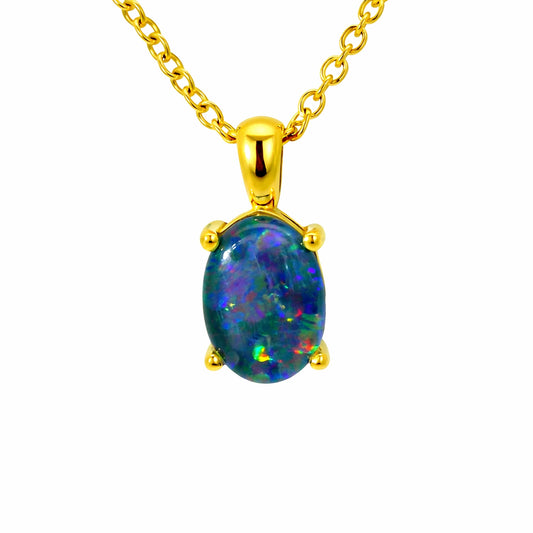
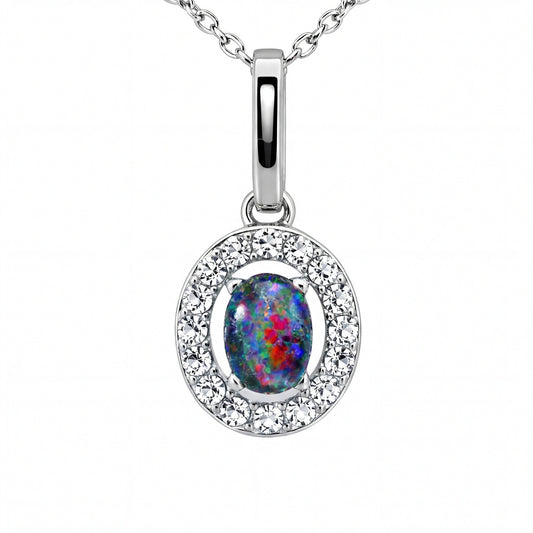
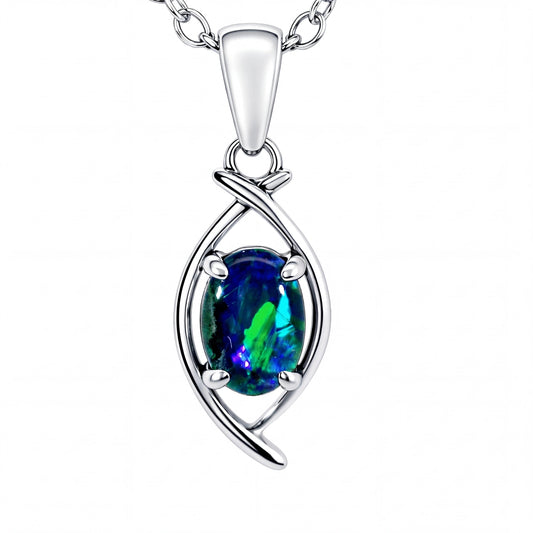
PendantA pendant tends to hang in a repeatable orientation. A more directional stone can work beautifully if the strongest face points outward in the natural resting position. |
|
|
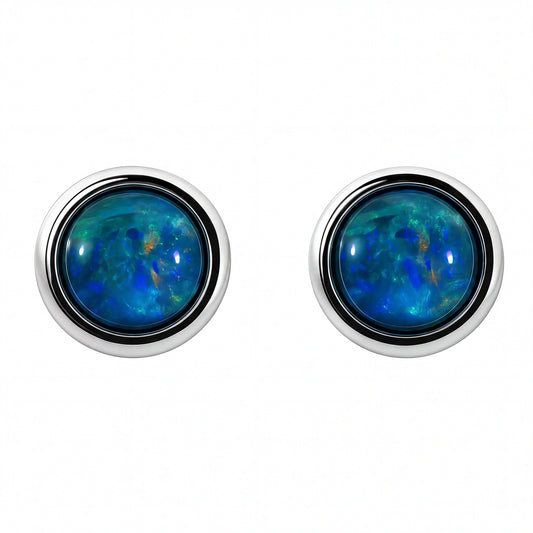
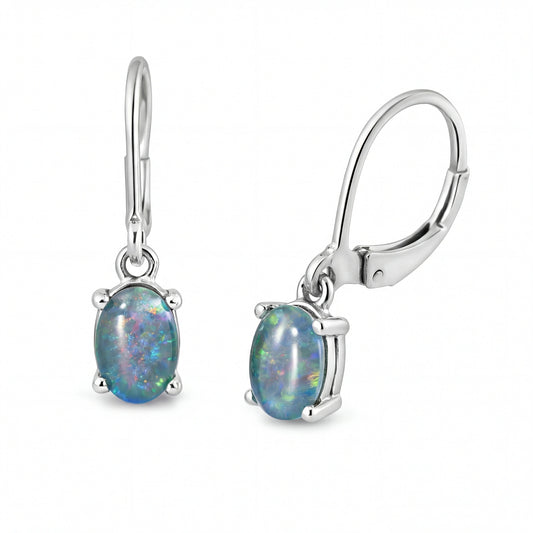
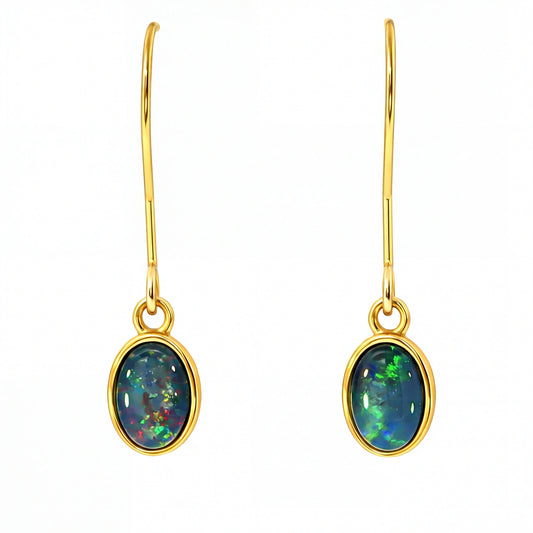
EarringsPairing matters. Exact mirror images are rare, so balance may come from similar scale, colour and overall energy rather than identical pattern. |
|
|
Loose collector stoneA loose stone can be appreciated from controlled angles and may prioritise visual rarity over everyday practicality. |


Questions to ask the seller
- What body-tone classification are you using?
- Is this solid opal, boulder opal or an assembled product?
- Has treatment been detected or declared?
- Which direction is intended as the face?
- How broad is the colour display?
- Are there any stability or condition concerns?
- Why was this outline and dome chosen?
- Is the photograph the exact stone?
- What documentation accompanies it?
Frequently asked questions
Does black opal have to look black?
It needs a sufficiently dark body tone when viewed face-up. The visible play-of-colour may be blue, green, red, orange, violet or a combination.
Is the darkest body tone always the most valuable?
No. Body tone interacts with brightness, colour, pattern, direction, cut, condition and overall appeal.
Is red always better than blue?
Red is traditionally highly prized, but brightness, distribution and personal preference matter. A superb blue-green stone can be more compelling than a weak red display.
What is directional colour?
It means the strongest play-of-colour is visible from a more limited angle. The significance depends on how the stone will be viewed or set.
Can I compare black opals online?
Yes, but ask for consistent video, multiple angles, dimensions and exact-item confirmation. In-person comparison remains valuable for a significant purchase.
Learn to see before deciding
The best black opal is not discovered by memorising one hierarchy. It is found by learning to observe several qualities together.
Australian Opal Cutters can prepare a focused comparison of current black opal jewellery and loose black opals at the Sydney showroom when contacted in advance. Ask for fewer stones, a fair comparison and enough time to look slowly.